
Keeping her running.
Knowing what’s due is the easy halfEvery maintenance app can hold a schedule. The schedule is not the hard part. The hard part is everything around it — the hours the intervals are counted from, the parts you need before you can start, the vendor who did it last time, and the record of what actually happened. Those are what turn a calendar into a maintained boat.
Schedules that start populated
Maintenance templates for the major brands — Volvo Penta, MAN, CAT, Cummins, Yanmar, Onan, Northern Lights, MerCruiser, Seakeeper, Side-Power and Lewmar — so service schedules begin with content instead of beginning blank. A blank schedule is a schedule nobody fills in.
Intervals run on hours or on dates, whichever the job actually follows, and marking one done pre-fills the next due date so the schedule rolls forward on its own. Urgency is computed live from that date rather than read from a status written the last time the row was saved — so “6 overdue · 14 due in 30 days” means the same thing on every screen that says it.
Hours, two ways, treated the same
Service intervals are only as good as the hour readings behind them.
- Manually, with a reminder you set — after the number of days you choose, and only once a trip has ended since the last reading. The app prompts at the right moment; tap, confirm, done.
- Automatically, from your NMEA 2000 network. Engine hours accrue into the record on their own, without burying the history in near-duplicates.
- Live, from the same bus — depth, temperatures, voltages, tank levels and engine data on the display as they happen, with a reading saved into the record whenever one is worth keeping.
Getting an NMEA gateway talking to a phone is normally an afternoon with a manual. theONE has a connect-a-device flow that picks the vendor, looks for the gateway on the boat's Wi-Fi, tests the connection, names it and saves it — because a feature nobody can get set up is a feature nobody has.
The engine-hour checks then do the arithmetic properly: intervals due and overdue, burn-rate anomalies, and a gateway’s hour reading that has started to disagree with the log. There is a fourth — a nudge when an hour log has gone stale — and it ships switched off, because not every boat wants to be asked.
Work orders
When a job is real, it becomes a work order — with a number, a scope of items, a vendor, and a closeout that keeps “is the fault gone” and “was the vendor’s work good” as two separate answers. That flow is the spine of the app and it has its own page.
Systems, not “the engines”
Work belongs to a unit. The port main, not “mains”. Genset 1, not “genset”. Every system carries its make, model, serial, install date and last documented service, and every job, document, spare and hour reading hangs off the specific unit it concerns. It is the difference between a history you can read and a pile you can search.
Every photo of the bilge you have ever taken
Photographs of a boat are taken constantly and found never. They go into a camera roll of eleven thousand images alongside the dog and the sunset, and the one you want — the bilge in March, before it started weeping — is unfindable by the time it matters.
So a photo taken in theONE can be tagged to a zone: bilge, engine room, helm, galley, master, crew, deck, flybridge. Open a system and there is a strip of the latest twelve images captured in its zone, newest first, swipeable in one gesture.
“Show me the latest bilge photos on this boat” stops being a search and becomes a swipe.
That is what turns a photo from a memory into evidence. A slow leak, a spreading stain, corrosion creeping along a bracket — none of them are visible in one photograph and all of them are obvious in eight of the same place across two seasons.
Tenders and toys are boats too
The tender has an engine, an impeller and a service interval. So does the jet ski, and the generator on the davit. They are tracked as their own systems with their own jobs and their own history, and they are kept off the vessel’s maintenance board unless you want them there — one toggle, because a captain planning a yard visit for the mains does not want the paddleboard in the list, and the person servicing the tender wants nothing else.
The parts you need to actually start
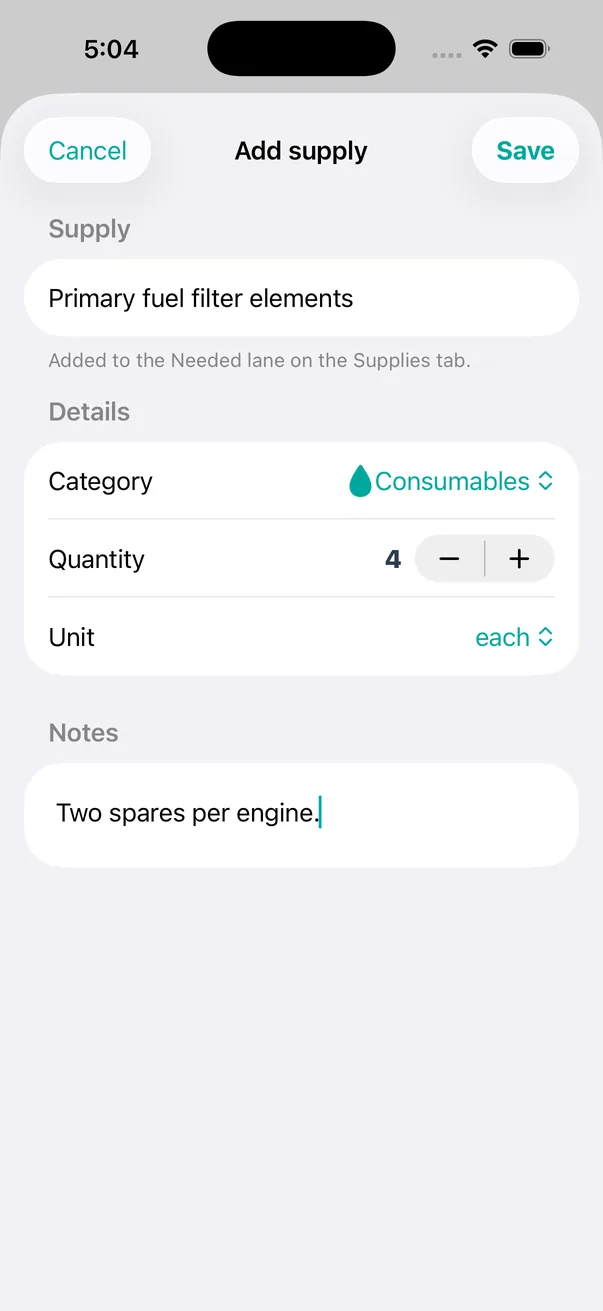
A job you cannot begin for want of an impeller is not really scheduled, so stowage is part of maintenance rather than a separate hobby.
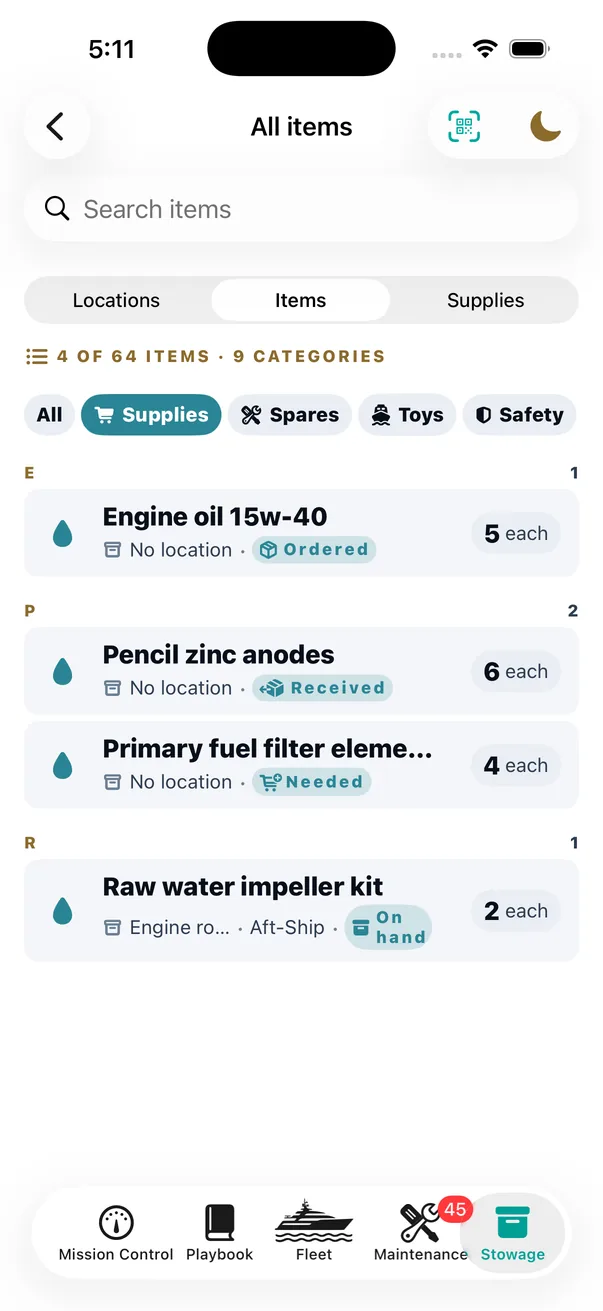
A part moves needed → ordered → received → on hand, and only the last state carries a stowage location — because the other three genuinely do not have one yet. Most inventory systems demand a location the moment something arrives, which is how a shelf ends up lying to you.
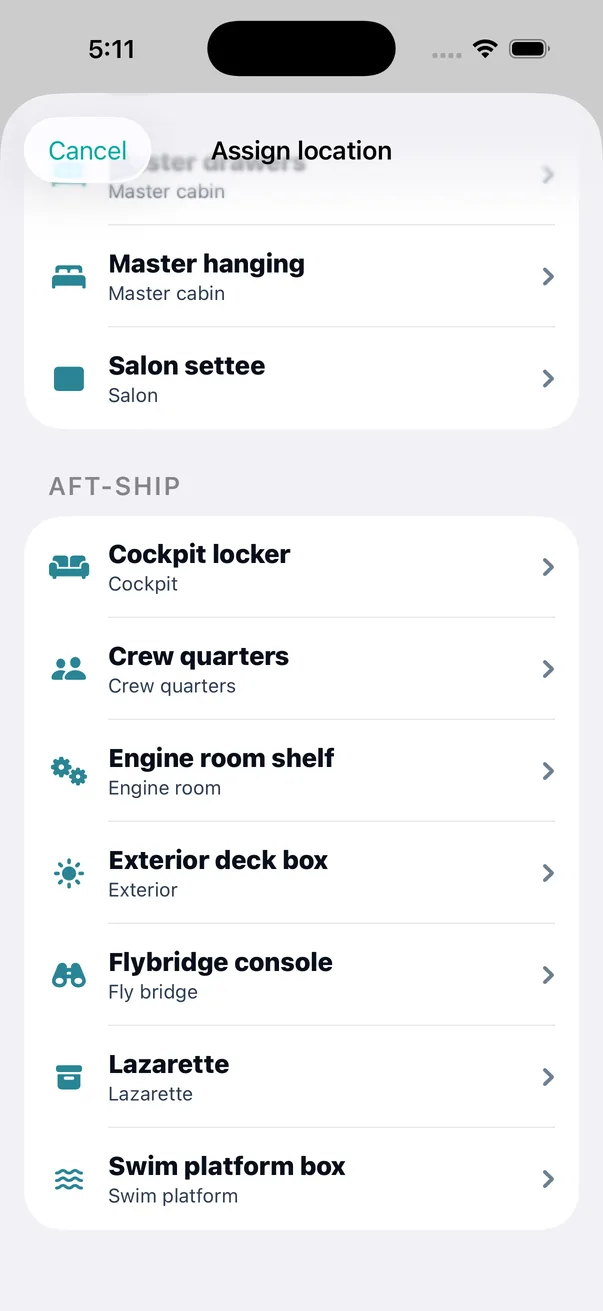
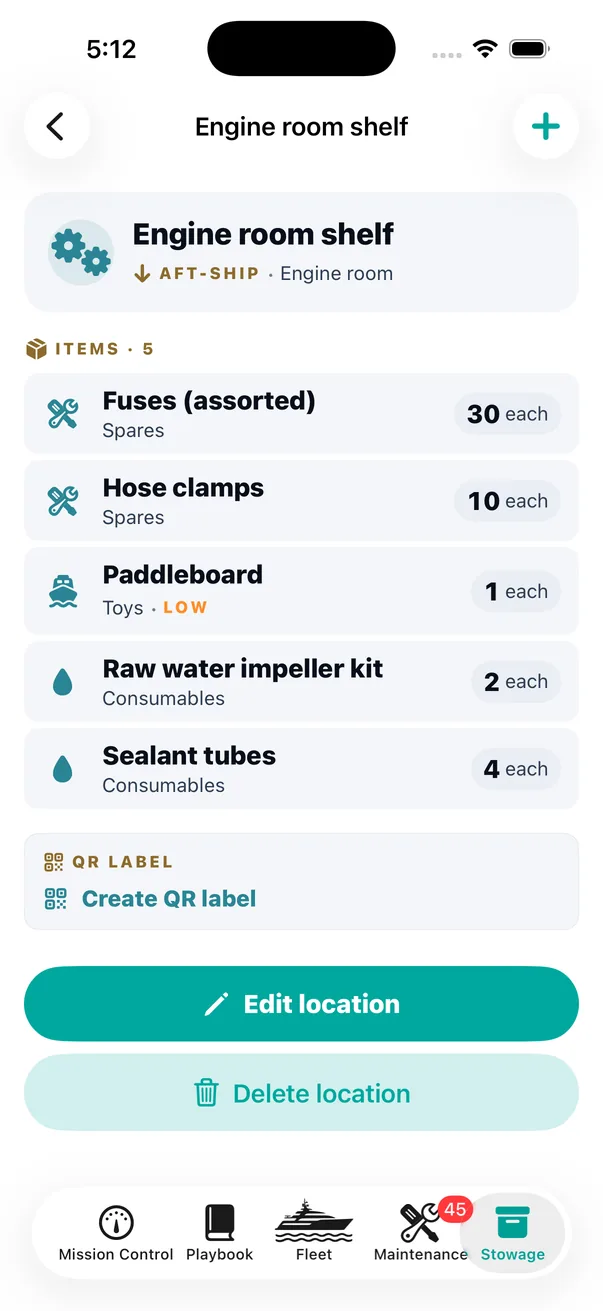
Once it is on hand it lives in exactly one place, and moving it is logged. Locations are organised the way a boat is: Fore-Ship, Mid-Ship, Aft-Ship, with finer zones — bow, cockpit, salon, galley, master, guest, crew quarters, engine room, lazarette, fly bridge, swim platform — because a thirty-locker boat as one flat list is not a list anybody reads.
And a spare can be linked to the system it serves, so the raw-water impellers appear inside the tender’s own screen. You find the part where you were already standing, not by remembering what you called it.
Then it is plain-word search: spare impeller, flare kit, the good corkscrew. Crew look things up without calling the captain, which is the actual measure of whether a stowage system works.
Or skip the search entirely
Print a QR label for a locker and stick it on the door. Scan it with the phone and you are looking at what is inside — no searching, no remembering what you called the locker, no knowing the app. Point at the door, read the contents. A new deckhand can do it.
Fuel, logged
Fills go in with volume, price and location, against the tank they went into. That is what makes burn rate real rather than remembered — and it is the number that tells you an engine has started drinking before anything else does.
Vendors, and the work they actually did
A vendor is a card with contacts, work sessions and history — not a phone number in a note. Work is assigned to them, signed off against them, and stays attached to their card. So “who did the last impeller, and how did that go?” is a question with an answer rather than a memory. That history is also what the Insurance Export draws on.
In the Help Center
Honest about the edges
Templates are a starting point, not your maintenance plan. They reflect manufacturer intervals for the common brands. Your boat, your climate, your hours and your yard’s advice all beat a template, and theONE expects you to edit them.
NMEA 2000 telemetry is as good as the network feeding it. theONE reads what the bus reports. A sender that is out of calibration produces a tidy log of wrong numbers, and no app can tell you otherwise.
Inventory is only true if somebody updates it. Nothing here counts what is on the shelf. The four states exist to make honest updating cheap — not to guarantee it happened.
Why the whole loop, and not just the schedule
Because a schedule tells you what to do and a record tells you what happened, and only one of those is worth anything eighteen months later. It is also, not incidentally, exactly what Foresight draws on — a job with a real outcome on the end of it is a complete sentence. A job that just stops is not.