The boat, run the same way every time.
The boat, running the same way every timeMost of what keeps a vessel safe is not written down anywhere. It is in one person's head — the order they check things in, the thing they always look at twice, the step everyone forgets. That works until the person with the head is not aboard.
The knowledge problem
A relief captain takes her out for a week. A new mate joins mid-season. The owner runs the boat himself for the first time in a year. In every one of those cases the boat is the same and the procedure is not, because the procedure was never a document — it was a habit.
A boat should not run differently depending on who happens to be aboard.
Paper checklists solve this badly. They get photocopied, annotated, lost, and — worst of all — they get ticked. A completed paper checklist tells you a box was ticked. It does not tell you who ticked it, when, whether they actually did the thing, or what they found when they did.
A playbook is the procedure. A run is what happened.
theONE ships nine kinds: Pre-Departure, Underway, Anchoring, Refueling, Post-Trip, Maintenance, Emergency, Extreme Weather, and Custom for whatever your boat needs that nobody thought of. Each is a list of items, and each item is assigned to a crew position — so the engine-room round belongs to engineering and the lines belong to deck, whoever happens to be filling those roles this week.
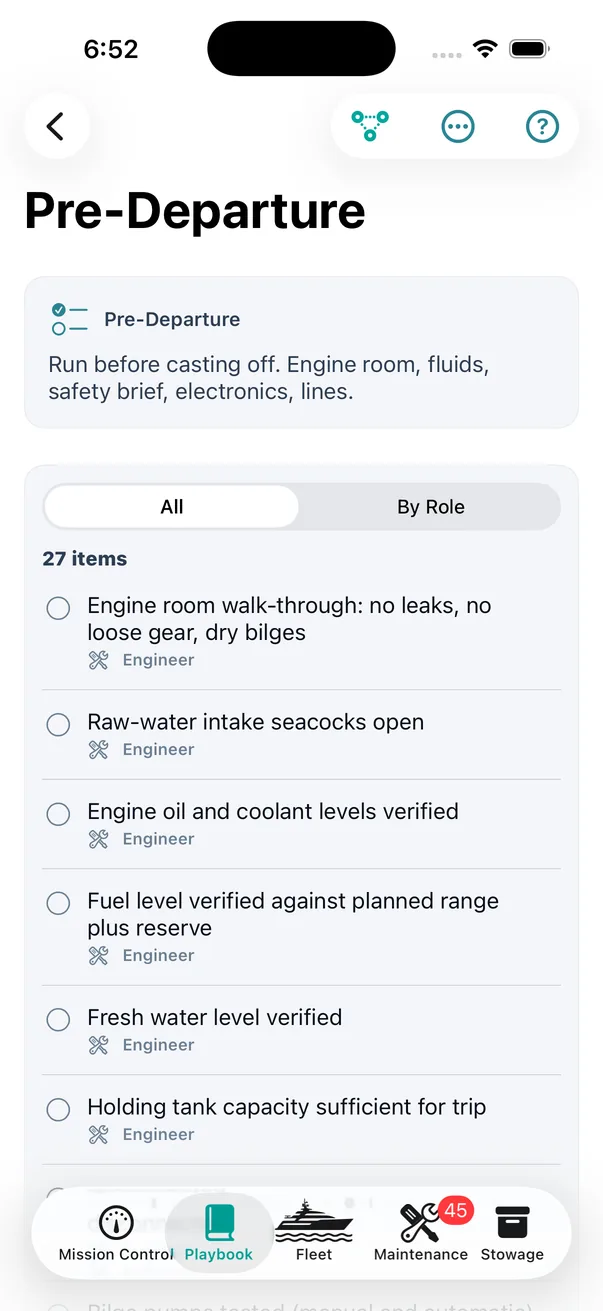
Then you run it. And the run is where this stops being a checklist app:
- Every check is attributed. Who ticked it, and at what time. Not "someone did this" — a name and a timestamp.
- A check can carry a note and photos. "Port seacock stiff, freed it" is worth more than a tick, and the photo of the thing you were unsure about goes in the record.
- A skip asks why. Steps get skipped legitimately all the time. theONE records that it was skipped and the reason given, rather than letting it silently read as done.
- The run is pinned to the playbook's version. Playbooks get edited; versions are bumped. A run from March is auditable against the checklist as it existed in March, not as it reads today. That is the difference between a record and a claim.
Look at what each item offers while you are running it. Photo and note are obvious. Two others are the ones that matter: raise an observation from a check, because the moment you find something is the moment to record it and not after the trip; and raise a work order, because “that wants doing properly” is a thought that otherwise evaporates between the engine room and the helm.
A checklist that can only be ticked loses everything the person ticking it noticed.
Readiness: one number, and what's behind it
A run in progress lifts the trip's readiness score, and that score is on Mission Control before you leave the dock. It is the number a captain actually wants at 0700 — not a list, a state.
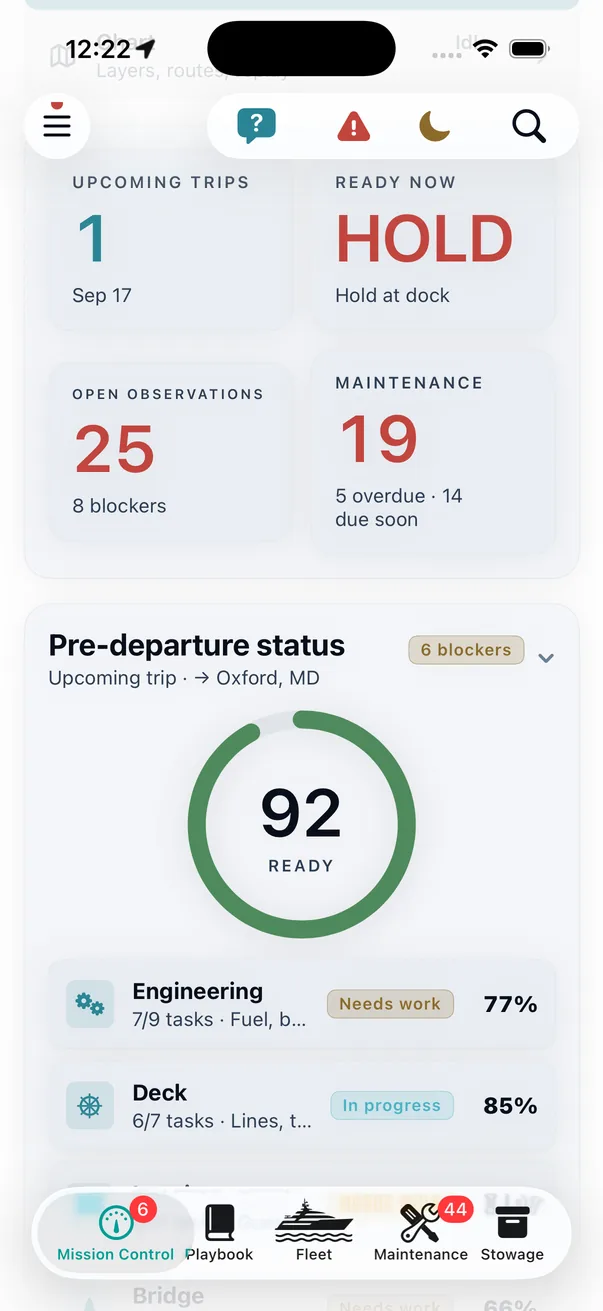
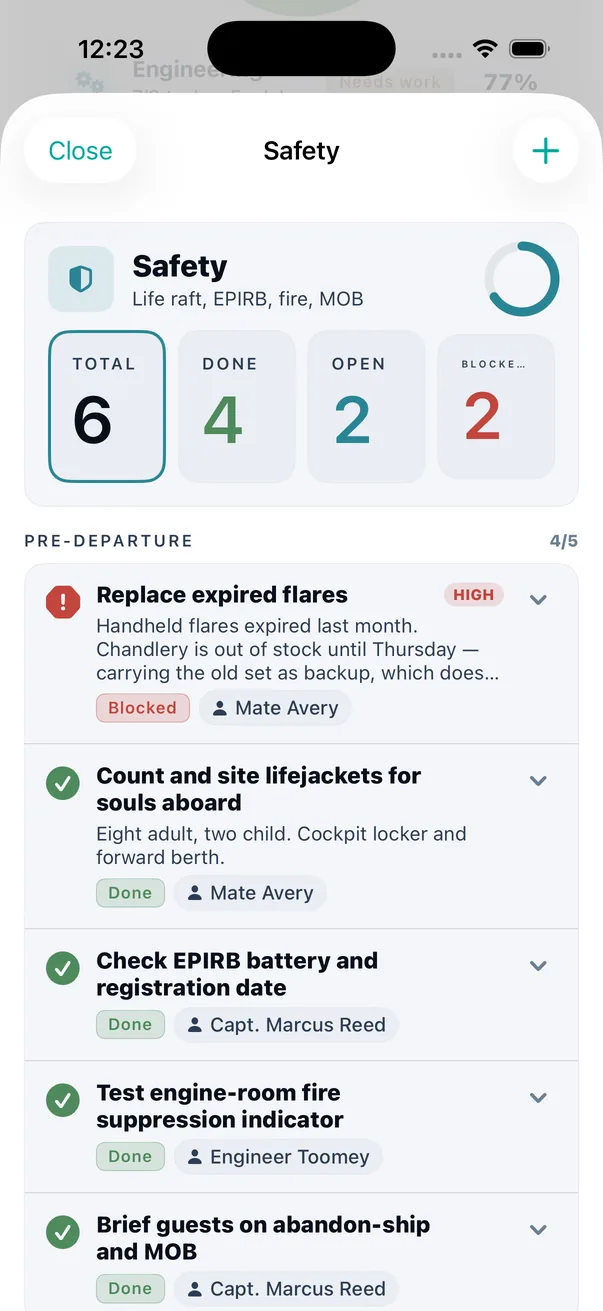
Behind it sits a breakdown by department — Engineering, Deck, Interior, Bridge, Electrical, Hull, Safety — built from the trip's own task lists. Tap a department and you get exactly what is done and what is left, and you can work it from there. A captain deciding whether to go does not want a percentage; he wants to know engineering is clear and the deck has one thing outstanding.
The two halves connect where it matters: apply a playbook to a department and its steps become that department's tasks, so a written procedure turns into the thing the readiness number is counting. A run on its own moves the overall figure rather than the per-department split — and now you know which is which, rather than finding out on the dock.
Playbooks are assigned by role — and to specific people where you need that. A mate sees the playbooks a mate runs.
Built once, reused
Items can be drawn from a shared library rather than retyped for every playbook, and runs can be put on a repeating schedule. The two that matter most surface on their own: the pre-departure playbook is pulled into the departure brief, and the post-trip one comes up as you end the cruise — before you leave, and while you still remember, rather than a week later.
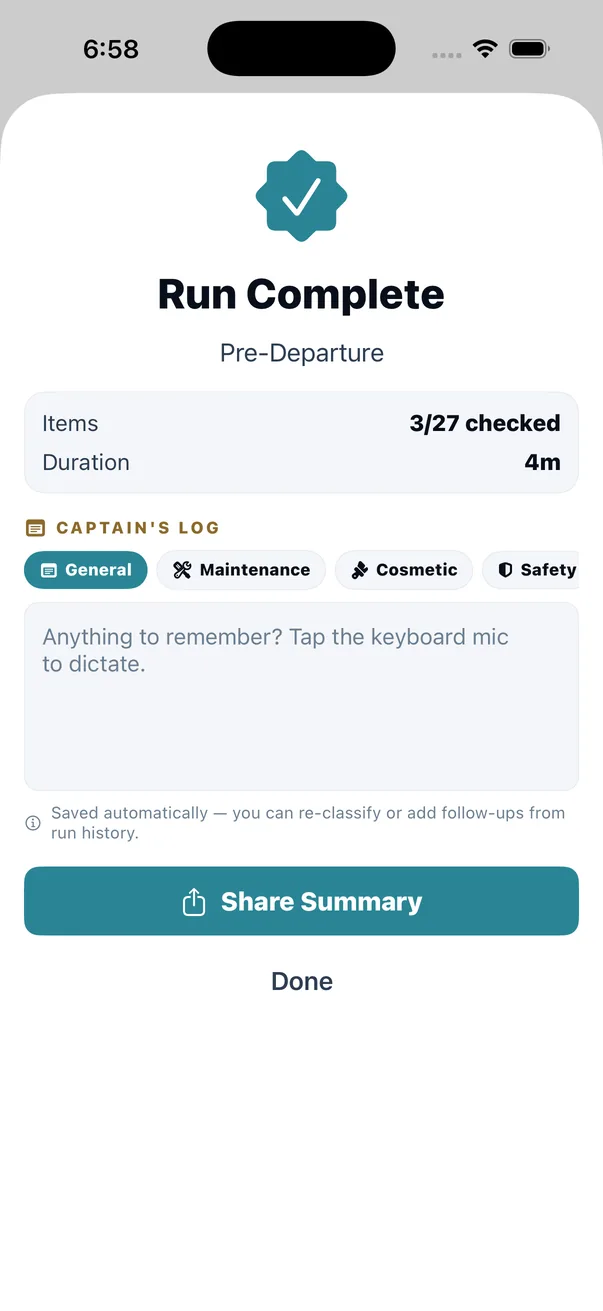
The log at the end is the part people underestimate. A run tells you what was checked; the captain's sentence at the close tells you what it was like — the seacock that was stiff, the smell in the lazarette, the thing that was fine but you did not like. That is the entry nobody ever writes an hour later, so the app asks while you are still standing there, with a microphone, and files it against the run.
A completed run exports as a PDF summary straight out of the share sheet. That is what you hand a relief captain, a surveyor, or an owner who wants to know how the boat is actually being run — and it is the difference between saying the checks were done and showing that they were.
In the Help Center
Honest about the edges
A playbook does not check anything for you. It records that a person said they did. The value is in attribution, notes, photos and skip reasons — an honest record of a real procedure — not in the software verifying the seacock. Nothing can do that from a phone.
Readiness is only as meaningful as the playbook behind it. A score of 100 against a three-item checklist tells you very little. The number reflects what you decided to check, which is a decision the app cannot make for you.
Emergency playbooks are preparation, not a substitute for training. They supplement — they never replace — proper seamanship, drills, and USCG requirements.
Why it matters more than it sounds
Because "we always do it this way" is the single largest body of undocumented knowledge on any well-run boat, and it walks off the dock every time the crew changes. A playbook is that knowledge written down once, run the same way every time, and left behind as evidence that it was.