
Capture in ten seconds. File it later.
Where the record startsEvery logbook fails in the same place: not at the desk, at the moment of noticing. You are in the engine room with a light in one hand, or backing into a slip, or halfway through dinner with guests. That is when boats tell you things. It is the worst possible moment to file paperwork.
The gap where boat records die
The mate mentions a noise on the way in. You hear a new vibration at 2,300 RPM. The genset smells slightly wrong. Every one of those is a real datum with a real half-life — and in almost every case the same thing happens to it. You mean to write it down. You are busy. Twenty minutes later there are lines to coil and a guest asking about dinner, and by the time you are back at the table you have either forgotten it or reduced it to "something with the genset."
The information was never missing. It just never survived the twenty minutes between noticing it and having a hand free.
Most apps answer this by making you choose first. Is it maintenance? An issue? An observation? Pick the right screen, fill the right form, then you may write your sentence. That is a filing system asking you to do its job — and standing at the top of a ladder with a torch in your teeth, you will not do it.
Capture first. File later.
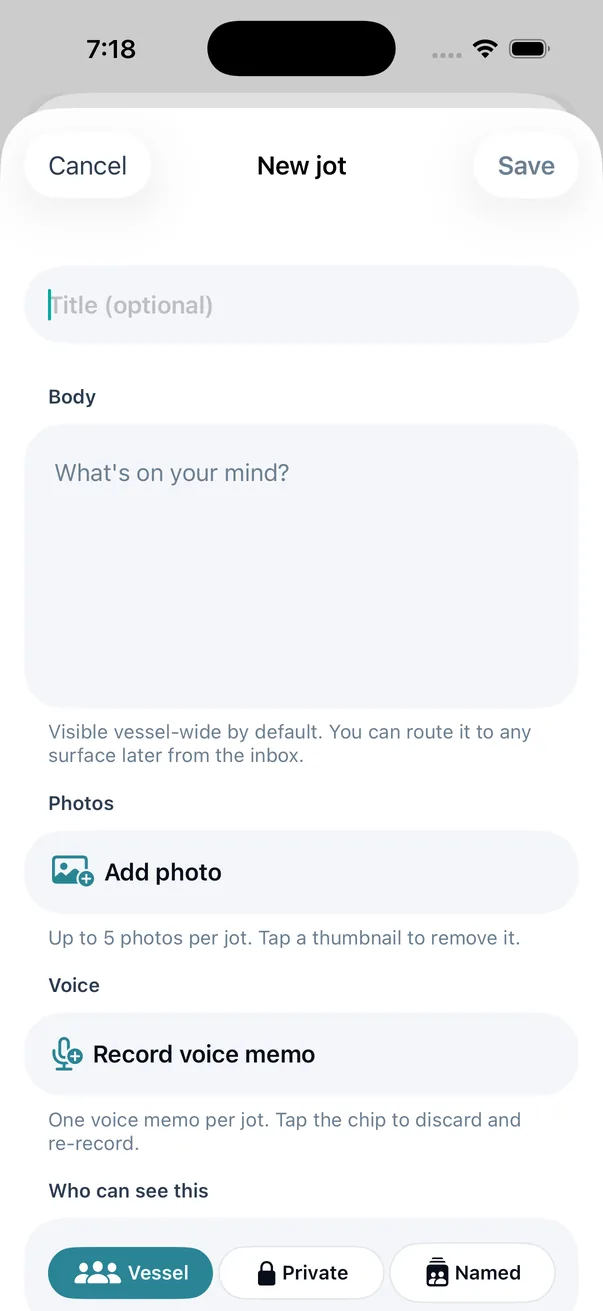
A jot is the smallest possible act of recording. Open it, say or type the thing, take a photo if there is one to take, done. No category. No required fields. No decision. It goes into the Jot Inbox and it waits for you.
Later — at the table, at the dock, on the drive home — you deal with the inbox. And this is where a jot stops being a note and starts being part of the boat's record: from the inbox, that same jot can become any of the things it might actually have been.
The routing is the point
An observation, an issue, a work order, evidence attached to an incident, a vendor, an entry on a trip or a specific leg, a step in a playbook, a stowage item, a supply to buy, a calendar task, a note or a document. One capture, any of those destinations, and you choose the destination when you have the context to choose properly — not while you are holding a torch.
What matters is that nothing detaches. Promote a jot to an issue, an observation or a work order and its photos come across with it (up to five for an observation or a work order). For the other destinations the attachments stay on the jot rather than being copied — and the jot itself stays in the inbox, linked to the record it became, so the photo and the voice memo are always one tap from the job they belong to. The record shows where it came from; the source shows where it went. Neither end goes looking for the other.
That link is what makes a jot worth more than a note. When a work order is read back in eighteen months, the photograph taken at the actual moment somebody first saw the problem is still attached to the chain — and a photograph beats a description written from memory a week later every time.
What it feeds
Jot is not a notepad bolted to the side of the app. It is the front door to most of what theONE does, which is exactly why it has its own page rather than living inside one feature:
- Routed to a work order, it becomes part of maintenance — with the photo that justified raising the job.
- Routed to an observation or an issue, it becomes a record Foresight can draw on. Chains start here.
- Attached to an incident, it becomes evidence — the shot of the damage, taken at the scene.
- Routed to a vendor, it becomes the thing you actually meant to tell the yard, instead of the thing you remembered to tell them.
And every one of those paths starts with an action short enough that you will actually take it while the boat is still telling you something.
In the Help Center
Honest about the edges
An inbox you never empty is just a pile. Jot moves the filing work; it does not delete it. theONE shows you the inbox and its count so it cannot quietly grow into a graveyard, but somebody still has to sit down and route them. Ten seconds of capture buys you the right to decide later — not the right to never decide.
A jot is not yet a record. Until you route it or link it to something, it is a note in an inbox: it will not appear in the Insurance Export or count against anything. That is deliberate — an unfiled thought should not become a line item in your vessel's official history without you saying so. Link it to a record and it does become part of that record's history, which is the point of linking it.
Photos migrate to issues, observations and work orders, not to everything. A photo carried across arrives as the thumbnail rather than the full-resolution original, and voice memos are never copied into a target at all — they stay on the jot. That is a real limit, and it is why the back-reference is not optional.
Voice notes are recordings, not transcripts. They attach, they play back, and they travel with whatever the jot becomes. theONE does not pretend to have turned your voice into a searchable maintenance entry.
Why it exists
Because the difference between a boat with a real history and a boat with a shoebox of receipts is almost never diligence. It is friction. Lower the cost of writing something down to nearly nothing and captains write things down — and eighteen months later, when it matters, the record is actually there.