Foresight™ — the boat tells you early. Nothing else writes it down.
A marine app that knows what normal looks like on your boatEvery marine app can tell you an oil change is due in 40 hours. That is a countdown. theONE is built to tell you what a countdown cannot: it isn't running the way it was, and here is what that looked like the last time.
The problem with a service interval
A service interval knows one fact about your boat: a number went up. It does not know that the last time the starboard temperature crept at cruise, it was a raw-water impeller, and that you found it because the telltale spray looked weak, and that it took a haul-out to prove it. That knowledge exists — it is sitting in your logs — but in every other app it is inert. It goes in and it never comes back out.
The boat told you in May. Quietly, in a way that looked like nothing. The bill came in August.
What Foresight actually does
Everything you log — observations, issues, incidents, work orders — stays connected to what it led to. When a temperature note becomes an issue and a job closes the issue, theONE keeps the thread, not just the two ends. And when a thread reaches its end, how it ended is recorded — one of eight, not a free-text note: fixed and verified, fixed but unverified, worked around, not reproducible, deferred, rejected by the vendor, root cause inherent, or accepted by the captain.
Because that history lives in the boat’s own record, Foresight can recognise it when it starts to repeat — on the other engine, with a different crew, a year later — and bring it to you with how it ended.
Why it speaks across engines and years
It works across two different engines, two different crew, or two different years: a chain that began on the port main can raise a flag on the starboard one. What repeats is the pattern.
It only looks back at history that actually reached an outcome — a guess with no ending tells you nothing. And it has to be sure enough to say anything at all: below that, theONE stays quiet rather than filling your inbox with maybes.
Four engines
Two of these watch for trouble with a pattern to it. One does the arithmetic — properly, against real hours. One reads the forecast and tells you when you can get the outdoor jobs done. All four exist to catch a small job before it becomes a big one.
| Engine | What it watches |
|---|---|
| Foresight™ | Repeating causal chains. "This looks like the chain that ended in the July alternator failure." |
| Engine-hour checks | The arithmetic, done properly — intervals coming due, intervals overdue, burn-rate anomalies, and a gateway’s hour reading that disagrees with the log. And a nudge when an hour log has gone stale, which ships switched off for anyone who wants it. |
| Departure Windows | Ranks the next 72 hours on four criteria — daylight, wind at or under 15 knots, no active marine alert at your position, and a favourable tide — so you know when to leave, not just what the weather is. |
| Dry Windows | Lines the forecast up against the outdoor jobs the schedule already says are due, and gives you the run of days to do them in: “Three dry days from Thursday — the varnish and the impeller are both due.” Daytime periods only, at or under a 20% chance of rain and 15 knots of wind, and it wants at least two of them back to back. Outdoor work only — anything on the hull or the deck, and anything whose name says varnish, paint, teak, canvas, antifouling and the like. An oil change does not need a dry Thursday. |
Dry Windows keeps nothing. It is recomputed from the live forecast every time the list is drawn, because a card that still says “three dry days from Thursday” on Sunday afternoon is worse than no card. Departure Windows is the same kind of fact and keeps nothing either. Only Foresight and the engine-hour checks leave a record behind; the two that read the weather write a sentence and then forget it.
Three of them share one inbox: Foresight, the engine-hour checks and Dry Windows all raise into the same list, so a captain does not have to check three screens to find out his boat is trying to tell him something. Dry Windows sits at the top of it, above the unread, because it is the one card with a date on it and the date is the thing you plan around. Departure Windows sits with Ready Now instead — it belongs at the moment you are deciding whether to go, not in a queue you read later.
No black boxes
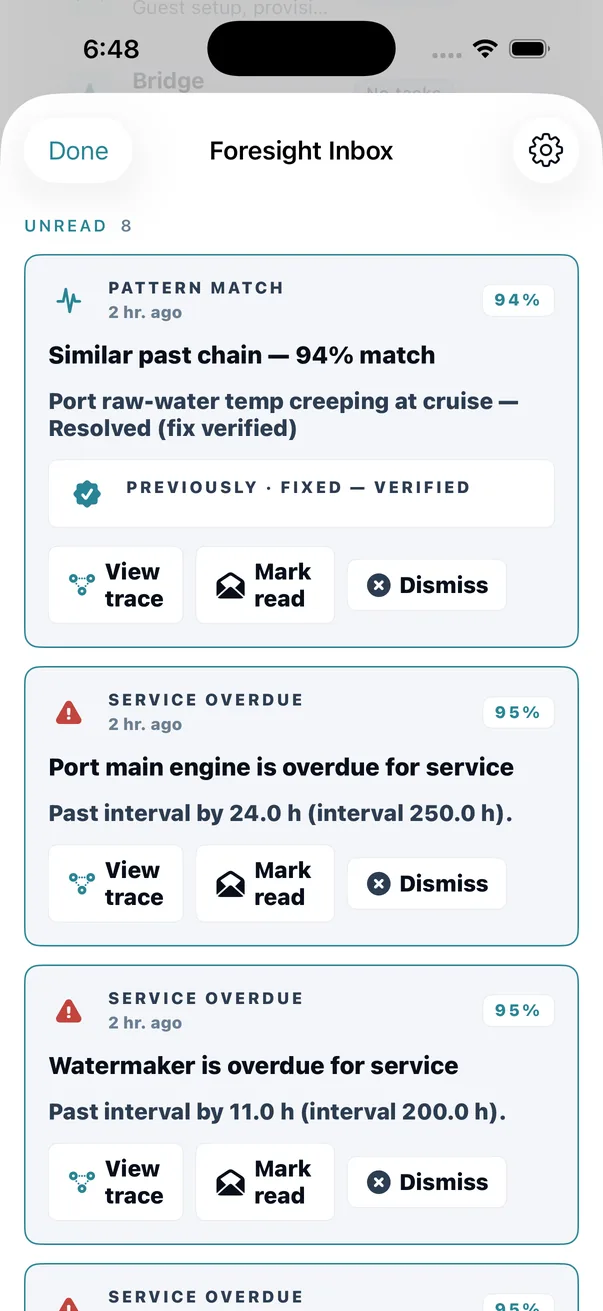
Every warning Foresight raises carries its evidence on the face of the card: a PREVIOUSLY block naming the outcome of the prior chain it matched, and when that chain ended. Not a number with no source — the actual prior ending, typed, sitting next to the match percentage.
Being precise about what that block holds: the outcome, the date, the first line of the resolution note, and the name of whoever closed that prior chain. An earlier build rendered only the first two and this page said so; the step that produces the card now passes all four through, so the sentence that used to sit here has been retired rather than left standing.
From there, View trace opens the record inside its own history, with the links in and the links out drawn explicitly, each one carrying the reason it was drawn. Tap any one of them and a Why? pane shows why theONE drew that connection, how sure it is of it, and when it was established. So the chain is walkable, one honest step at a time.
Even the trace tells you where it stopped. Walk a big enough history and the view tells you it stopped and that more links exist, rather than quietly showing you a partial picture as though it were the whole one. A limit you can see is a limit you can work around; a limit you cannot see is a wrong answer.
This is not a courtesy. A warning you cannot audit is a warning you will eventually learn to ignore, and an alert a captain ignores is worse than no alert. If Foresight cannot show you why, it has not earned the interruption.
In the Help Center
Honest about the edges
It needs history before it says anything. Foresight reasons from your boat's own record, so on a brand-new install it has nothing to reason from and it will be quiet. That is correct behaviour, not a fault — but it means the value builds over a season rather than arriving on day one. The engine-hour checks and Departure Windows work immediately; the pattern-matching earns its keep as you log.
It is only as sharp as your closeouts. A job closed with no reason is a lesson thrown away — which is why closing a record asks how it was resolved. Answer honestly, including “worked around” and “not reproducible”, and the next warning is worth reading. Close everything as “fixed” and you are comparing today against things that never happened.
It is a memory, not a prophecy. Foresight does not guess at what your boat might do. It tells you where today resembles a day you have already paid for — and it has no opinion at all about a fault your boat has never had. That restraint is the point. An app that cries wolf gets ignored by month two. One that speaks only when it recognises something real is one you will still be reading at 2am in a following sea. It never replaces a competent mechanic or your own judgement.
Why we built it
Because the information was always there. Boats are astonishingly well documented and astonishingly badly remembered — the logs exist, the invoices exist, the notes exist, and they are scattered across a binder, a spreadsheet, a group text and a mechanic's memory. The failure is not data collection. It is that nothing ever reads it back.
Foresight is the part of theONE that reads it back.